
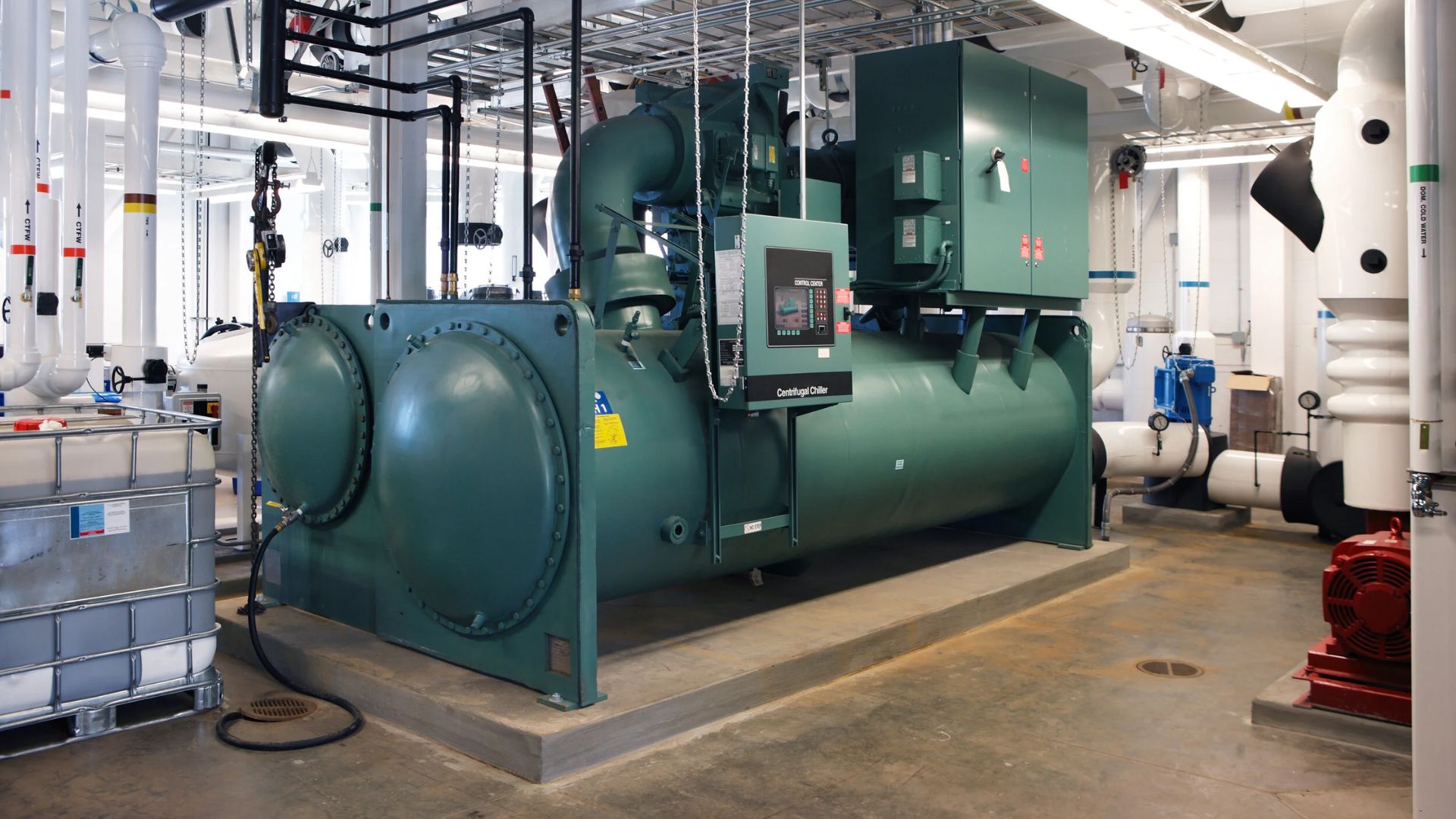
Cooling can look like a pure cost decision until the maintenance reality shows up. Many facilities using water-cooled systems rely on cooling towers, and the CDC notes that cooling towers release aerosolized water; if Legionella is present, those droplets can spread bacteria.
In other words, your “cooling choice” affects risk ownership, not just efficiency.
This guide breaks down how industrial chillers work, the main chiller types you’ll see in manufacturing, and what each type changes on the floor. You’ll also get a practical way to choose so you can avoid mismatched quotes and keep production steady.
Quick Summary:
Chiller Types That Actually Matter — Classify industrial chillers by heat rejection (air/water/evaporative) and compressor type, not vague labels.
How the System Really Works — The process loop and heat-rejection side behave differently, and mixing them up causes bad sizing and bad troubleshooting.
2-Minute Selection Filter — Match your choice to load profile, utilities, maintenance bandwidth, and expansion plans to avoid “works on day one” failures.
RFQ Checklist That Forces Apples-to-Apples Quotes — Lock leaving temp, flow, return conditions, rated assumptions, commissioning, alarms, and service access in writing.
Local Integration Help — In IL/WI/MN/ND/SD, Aqua Poly can sanity-check scope and integration before you approve industrial chiller quotes.
What an Industrial Chiller Does in Plain Plant Terms
An industrial chiller is a heat mover. It pulls heat out of a circulating process fluid and dumps that heat somewhere else, either to ambient air or to a condenser water loop that usually rejects heat through a cooling tower. It does this continuously, so your process temperature stays predictable instead of drifting mid-run.
The basic refrigeration loop (4 core components)
Evaporator (where cooling happens): This is the “cold side.” Heat leaves your process fluid (water or glycol mix) and is absorbed into the refrigerant inside the evaporator. That’s how your loop gets chilled.
Compressor (the workhorse): The compressor drives the cycle by raising the refrigerant pressure so it can reject heat at a higher temperature. In plain terms, it’s what keeps heat moving in the right direction.
Condenser (where heat exits): This is the “hot side.” The refrigerant gives up the heat it picked up from your process and rejects it either to air (air-cooled) or to condenser water (water-cooled).
Expansion device (the reset button): The refrigerant pressure drops so it can become cold enough again to absorb heat in the evaporator. Then the loop repeats.
Here’s the part that trips people up: plants often say “the chiller” when they actually mean two different water circuits that behave very differently.
Quick question | Process loop | Heat-rejection side |
What’s its job? | Deliver cooling to loads and bring heat back to the chiller. | Dump that collected heat to air or condenser water (often to a tower). |
What moves through it? | Water or water/glycol (your “chilled water”). | Air (air-cooled) or condenser water (water-cooled). |
Where does temperature matter most? | At the machine: supply temp stability, ΔT, flow balance. | At the condenser: ambient conditions (air-cooled) or condenser-water conditions (water-cooled). |
What equipment is “on this side”? | Pumps, supply/return headers, piping/hoses to machines, filters/strainers, valves, sometimes a heat exchanger. | Condenser coil + fans (air-cooled) or condenser water pumps + piping + cooling tower (water-cooled). |
What “goes wrong” first in real plants? | Hot spots at specific machines, unstable temp, plugged strainers, flow imbalance, air in lines. | Capacity drop in hot weather, fouling/scaling, tower water management ownership surprises (water-cooled). |
Who usually owns it? | Production + maintenance (because it touches the process). | Facilities + maintenance (and sometimes outside water treatment vendor, for towers). |
Next: is your industrial chiller vapor-compression, or absorption (heat-driven)?
The Two Core Chiller Technologies: Vapor-Compression vs Absorption
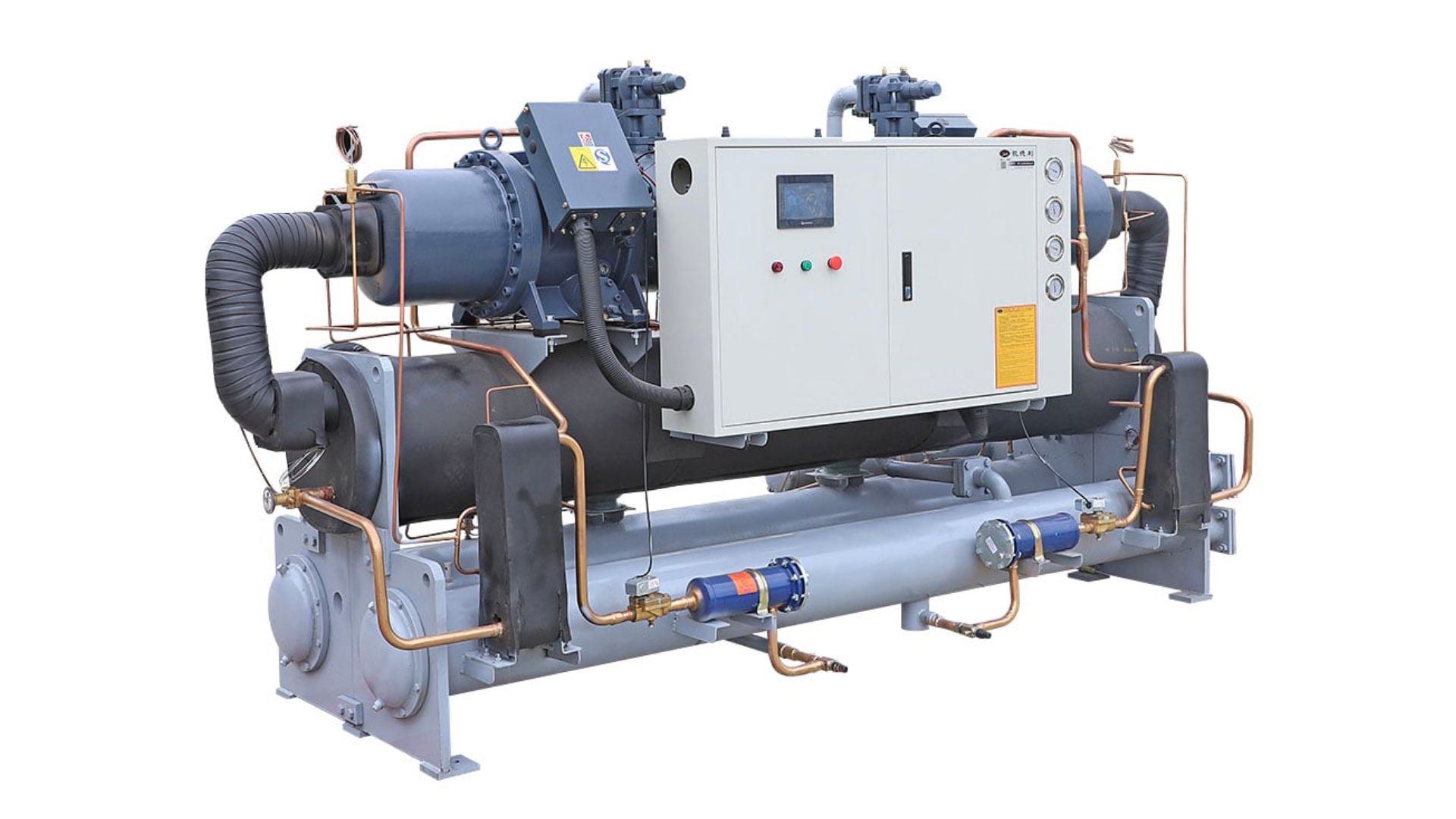
Most industrial chillers you’ll see in manufacturing are vapor-compression units. Absorption chillers show up when a site has usable heat like steam, hot water, or waste heat and wants cooling with lower compressor electric demand.
1. Vapor-compression chillers
This is the standard industrial chiller cycle, and it’s dominant because it’s flexible, scalable, and straightforward to control.
How it works:
Evaporator: Pulls heat out of your circulating process fluid and transfers it into the refrigerant.
Compressor: Raises refrigerant pressure so the system can push that heat out at the condenser.
Condenser: Rejects the heat to air (air-cooled) or to condenser water (water-cooled).
Expansion device: Drops refrigerant pressure so it can absorb heat again in the evaporator.
What the buyer controls (the “levers”):
Leaving fluid temperature and allowed stability band (what you promise production).
Flow and ΔT assumptions (what the chiller is sized around).
Heat rejection conditions (ambient for air-cooled, condenser-water conditions for water-cooled).
Best-fit scenarios:
You need reliable, continuous process cooling with clear temperature control.
You want broad equipment choice across sizes and layouts (air-cooled or water-cooled).
2. Absorption chillers
An absorption chiller is heat-driven, so it trades a big mechanical compressor for a heat source plus solution-side components.
How it works:
Evaporator: Refrigerant evaporates at low pressure and absorbs heat from the chilled water loop.
Absorber: Absorbent “soaks up” refrigerant vapor, which helps maintain low pressure and keep evaporation going.
Generator: Heat input drives refrigerant back out of the solution as vapor. This is the “heat replaces the compressor” moment.
Condenser: Refrigerant vapor condenses, rejecting heat to cooling water. Then it returns toward the evaporator to repeat the cycle.
What the buyer controls (the “levers”):
Quality and availability of the driving heat (steam or hot water temperature and consistency).
Cooling-water conditions for heat rejection (often tied to a tower loop).
Target chilled-water temperature and load profile (absorption likes steadier conditions).
Best-fit scenarios:
You have dependable waste heat or steam and want cooling without a large compressor load.
Your cooling demand is large and steady enough to justify the extra system complexity.
Now that you know the core chiller technology, the next decision is where that heat goes: to air, to a condenser-water loop (often a tower), or through an evaporative condenser setup.
Heat Rejection Types: Air-Cooled vs Water-Cooled vs Evaporatively-Cooled
This decision changes more than efficiency. It locks in your site footprint, your utility dependencies, and who owns the “not-in-the-quote” maintenance work once production is running.
Decision factor | Air-cooled | Water-cooled | Evaporatively-cooled |
Best when | Fast install, limited site utilities | Big, steady loads; central plant thinking | You want “tower-like” heat rejection without a full tower system |
Hidden scope that bites | Winter operation strategy, coil cleaning access | Tower program, water treatment, blowdown, makeup | Water quality + bleed control still matters, just packaged differently |
What degrades first | Condenser coil film/dirt → capacity drop | Tower/condenser fouling or approach issues → drift | Scaling on wetted surfaces → performance creep |
Utility dependency | Mostly electric | Electric + reliable water system | Electric + reliable water supply |
Commissioning gotcha | Rated performance vs real ambient at install location | Tower conditions must match assumptions | Water management settings decide real performance |
Ownership trap | “It’s undersized” when it’s actually airflow/placement | “Chiller problem” that’s actually tower water quality | “Low maintenance” promise that ignores water chemistry |
Placement constraint | Air recirculation, heat exhaust path | Space for tower + drift management | Needs outdoor placement and service access |
Climate sensitivity | High ambient hurts quickly | Water side can buffer, but tower limits still apply | Humidity impacts rejection; water management stays critical |
Once heat rejection is decided, the next “type” question is really about the compressor inside the industrial chiller.
Compressor-Based Types (The “Real” Meaning Behind Most “Chiller Types” Lists)
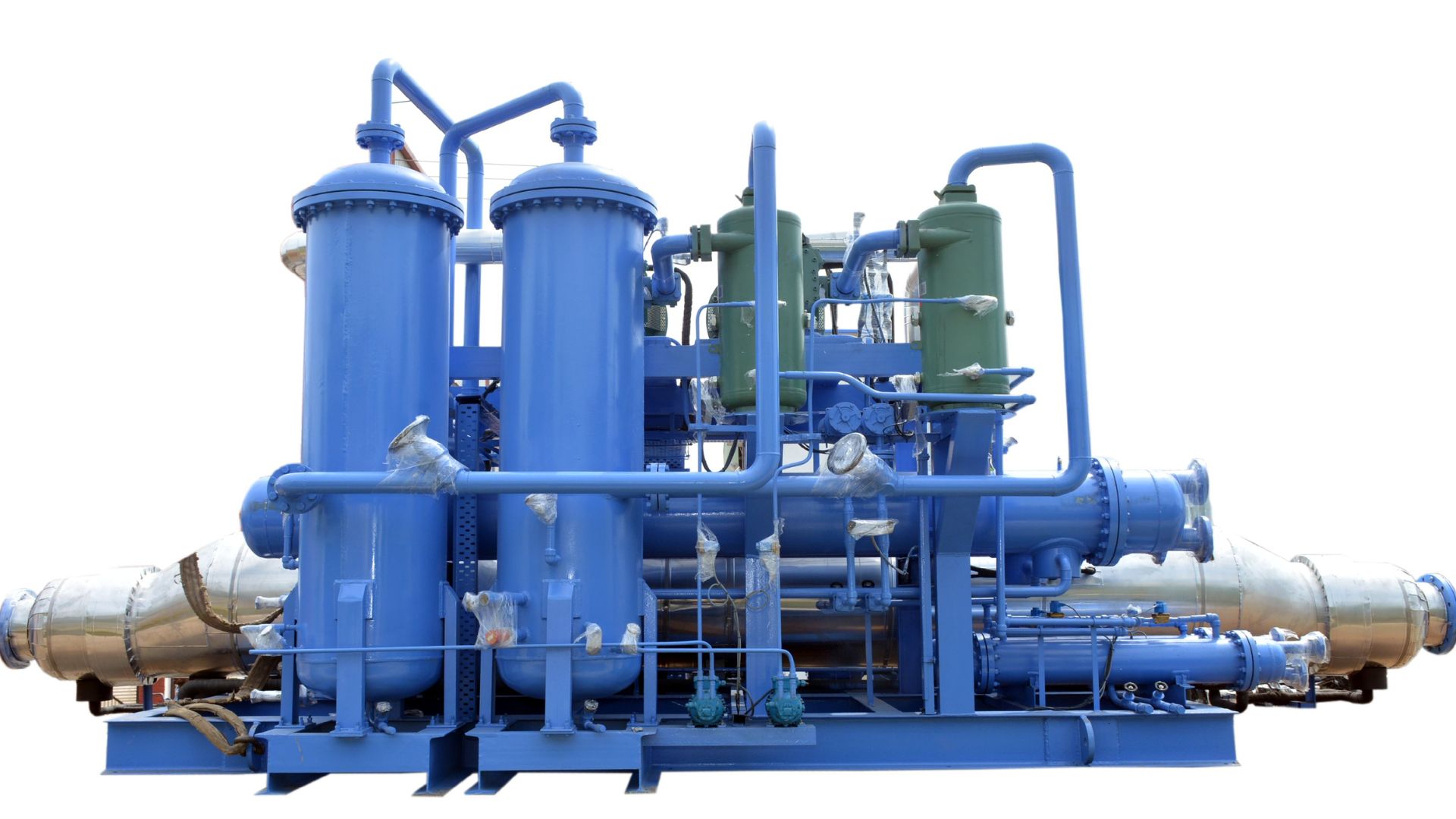
In vapor-compression industrial chillers, “type” usually means the compressor. That single choice shapes your realistic capacity range, how well the chiller behaves at part load, and what maintenance feels like over years.
1. Scroll Chillers
A compact, common choice for smaller industrial chiller loads where simplicity matters.
How they work: Scroll compressors trap refrigerant between two spiral elements and compress it continuously. Many units stage capacity by cycling multiple scrolls, and some use variable speed drives.
Best fit:
Smaller, distributed process loads that need predictable cooling
Sites that want straightforward service and faster swap/repair cycles
Applications with moderate turndown needs and stable operating hours
Watch-outs:
Frequent short-cycling can hurt efficiency and wear over time
Limited upside when you move into large, central-plant capacities
2.Reciprocating Chillers
A traditional compressor style still seen in smaller-capacity chillers and legacy installs.
How they work: A piston compresses refrigerant in a cylinder, like an engine in reverse. Capacity control is often step-based (staging/unloading) rather than smooth.
Best fit:
Smaller loads with steady duty cycles and predictable schedules
Plants that prioritize service familiarity and proven mechanics
Scenarios where staged capacity control is acceptable
Watch-outs:
More moving parts can mean more wear points if maintenance slips
Part-load control can feel “steppy” compared to modern screw/VFD setups
3. Screw Chillers
The go-to workhorse when you need mid-range capacity and stable industrial duty behavior.
How they work: Two helical rotors compress refrigerant with continuous flow. Capacity is commonly modulated via slide valve and/or variable speed drives for better turndown.
Best fit:
Medium-to-large process loads with long run hours
Plants that see variable load and need steadier leaving-fluid temperature
Facilities planning growth that may add loads in phases
Watch-outs:
Part-load efficiency depends heavily on the specific control strategy
Needs competent commissioning to avoid hunting or unstable control under swings
4. Centrifugal Chillers
Built for large capacities where a central plant approach makes economic and operational sense.
How they work: A high-speed impeller increases refrigerant velocity and pressure through centrifugal force. These systems shine at scale and are sensitive to proper design conditions and control.
Best fit:
Large, steady cooling demand where you operate most of the year
Sites that can support strong facilities ownership (water side + controls)
Plants that want high efficiency at scale with proper plant integration
Watch-outs:
Performance depends on staying close to intended operating conditions
A “simple chiller swap” rarely stays simple without plant-side design work
Next comes the part buyers actually care about: a fast checklist that helps you pick an industrial chiller direction without getting trapped by missing scope.
2-Minute Selection Checklist
This section is for buyers who want fewer surprises between “approved quote” and “stable production.” Use it like a decision filter, not a spec dump.
If your reality is… | Prioritize this | Default direction | Quick “don’t get burned” check |
You want the simplest install and minimal water-side ownership | Fewer utilities, fewer moving parts outside the skid | Air-cooled chiller | Confirm placement avoids hot-air recirculation and has coil-cleaning access |
You have a big, steady cooling load and can run a real facilities program | Lowest kW/ton at scale, central-plant economics | Water-cooled chiller + tower | Force tower assumptions in writing: condenser-water temps, treatment, blowdown, makeup |
You want tower-like rejection but don’t want a full tower system | Packaged evaporative rejection | Evaporatively-cooled | Require a clear water management plan (bleed control, scale control, service access) |
Your load is small to modest and split across areas | Simplicity, fast service | Scroll (or small screw) | Ask how turndown works (staging vs variable speed) and what prevents short-cycling |
Your load is mid-range, runs long hours, and swings during the day | Stable control under variable load | Screw | Specify leaving-fluid stability band and part-load control strategy (not just full-load tons) |
Your load is large and central-plant style | Efficiency at scale | Centrifugal | Confirm operating range expectations and plant-side integration needs (pumping, controls, tower side) |
You have freezing risk or low-temp needs | Freeze protection | Glycol loop (where needed) | Require fluid type/concentration assumptions and how it impacts capacity/pump sizing |
Downtime is expensive and you can’t “wait for parts” | Fault tolerance | N+1 / modular approach | Ask what happens if one circuit goes down: what capacity remains, what auto-recovery looks like |
Your plant struggles with “it drifted and nobody noticed” | Visibility, troubleshooting speed | Controls + trending as a spec item | Require: supply/return temps, DP/flow proof, alarms, and trend logs as standard scope |
You’re comparing multiple vendor quotes | Apples-to-apples scope | RFQ standardization | Force: rated conditions, exclusions list, commissioning plan, and acceptance test criteria |
Once you’ve picked a direction, this RFQ checklist forces every vendor to quote the same scope, so you’re comparing systems, not assumptions.
RFQ Checklist to Standardize Quotes
Most industrial chiller headaches start here: the quote looks clean, but key responsibilities sit in the fine print. This checklist is built to flush out hidden scope early. Copy/paste it into your RFQ so vendors must answer in plain language, and your team can compare proposals apples-to-apples.
A) Process requirements (basis of design)
Required leaving fluid temperature (°F/°C) and allowed stability band (+/–).
Design flow rate (GPM/LPM) and expected return temperature (or target ΔT).
Duty profile: steady/variable / batch; hours/day; peak load periods.
Fluid: water or glycol mix (type + %). State min ambient if freeze risk.
B) Performance and rating conditions
Cooling capacity (tons/kW) at stated leaving temp, return temp, flow, and:
Air-cooled: design ambient (dry-bulb).
Water-cooled: condenser-water entering temp + flow.
Full-load and part-load performance at the stated conditions.
Any derates assumed (glycol, altitude, fouling factors) must be listed.
C) Heat rejection scope
Identify configuration: air-cooled / water-cooled / evaporative.
State required clearances and airflow requirements (air-cooled).
State condenser-water requirements and assumed tower conditions (water-cooled).
State water use/bleed strategy assumptions (evaporative).
D) Hydraulics and package scope
Is process pumping included? If yes: pump type, head assumed, redundancy, VFD.
Minimum/maximum allowable flow through evaporator; flow proof method.
What is included “in skid” vs “by others” (valves, strainers, tank, piping).
E) Filtration and protection
Required filtration level and placement (chiller inlet / loop / point-of-use).
Protection target stated (evaporator, TCUs, molds, small passages).
Service access requirements for cleaning and filter changes.
F) Controls, alarms, and data
Required points: supply temp, return temp, setpoint, run status, alarms.
Minimum alarms: high/low temp, low flow, high pressure, pump/fan fault, freeze protection.
Trending/logging requirement and BMS/PLC interface (BACnet/Modbus/hardwired), if needed.
G) Utilities and site constraints
Electrical: voltage/phase/Hz, MCA/MOP, starting method.
Footprint, weight, noise limits; service clearances; indoor/outdoor rating.
Operating ambient limits and cold-weather strategy (if outdoor).
H) Commissioning and acceptance
Commissioning plan included (yes/no) and what tests are performed on-site.
Acceptance criteria: leaving temp stability, capacity under load, alarms verified, flow confirmed.
Post-start support: response time and responsibility during first 30–60 days.
I) Maintenance and support
Maintenance schedule and access requirements.
Recommended spares list + lead times.
Warranty terms and exclusions.
J) Commercial clarity
One-page list of exclusions and “by others.”
Lead time, shipping terms, and install supervision options.
If you’re in a territory-served region and want to sanity-check sizing inputs and quote assumptions, this is where a local engineering and integration partner can prevent expensive scope gaps.
How Aqua Poly Helps You Specify and Integrate the Right Chiller
Industrial chillers fail on paper when the system scope is fuzzy. That’s exactly where Aqua Poly Equipment Company steps in for manufacturers across Illinois, Wisconsin, Minnesota, North Dakota, and South Dakota.
The goal is to lock the real requirements early, define heat-rejection responsibilities, and make tie-ins and commissioning boundaries explicit, so quotes don’t turn into downtime surprises after install.
Process Cooling equipment access — Chillers, centrifugal pumps, and cooling towers sit under Process Cooling, so quotes can cover the full heat-rejection path when needed.
Engineering-led integration — In-house integration is built around the customer’s unique requirements, so the chiller is treated as part of a working plant system, not a standalone skid.
Temperature control support — Temperature control is a dedicated equipment area, which matters when “chiller issues” are actually stability issues at the process interface.
New + used equipment options — New and used plastics machinery and auxiliaries are both offered, which helps when timelines or budgets don’t match a single sourcing route.
Parts request pathway — A formal Request Parts route is available, so post-start support doesn’t depend on ad-hoc sourcing when something fails.
If your facility is in IL/WI/MN/ND/SD, Aqua Poly can help you sanity-check chiller scope and integration before you lock vendor quotes.
Conclusion
Chillers rarely fail on day one. They fail later, when load rises, temps drift, filters clog, and everyone argues whether it’s the chiller, the tower, or the loop. That’s usually a scope problem, not a mystery. Classify industrial chillers correctly (heat rejection type + compressor type), lock your leaving temperature, flow, and return conditions.
If you’re in Illinois, Wisconsin, Minnesota, North Dakota, or South Dakota, Contact Us to have Aqua Poly Equipment Company sanity-check your scope before you commit.
FAQs
1. Why do industrial chillers trip on “low flow” even when pumps are running?
Common causes are clogged strainers, air in the loop, incorrect valve positions, or a pump curve mismatch. It’s often a loop issue, not the chiller.
2. How do I tell if my industrial chiller is short-cycling, and why should I care?
Short-cycling is frequent start/stop behavior that hurts stability and wear. It usually comes from oversizing, low load periods, or poor turndown control.
3. What should I log daily to catch industrial chiller problems before they become downtime?
Track supply/return temps, ΔT, and alarms/trips. One week of trend data often reveals whether it’s load, flow, or heat rejection.
4. Why do only certain machines run hot when the industrial chiller setpoint looks normal?
Flow imbalance and long branch runs are typical. The chiller can be fine while one area starves for flow or loses cooling to restrictions.
5. What are the most common “by others” items that get missed in industrial chiller projects?
Pumps/valves/strainers, electrical disconnects, tower water treatment and blowdown, glycol fill, commissioning responsibilities, and acceptance testing.


