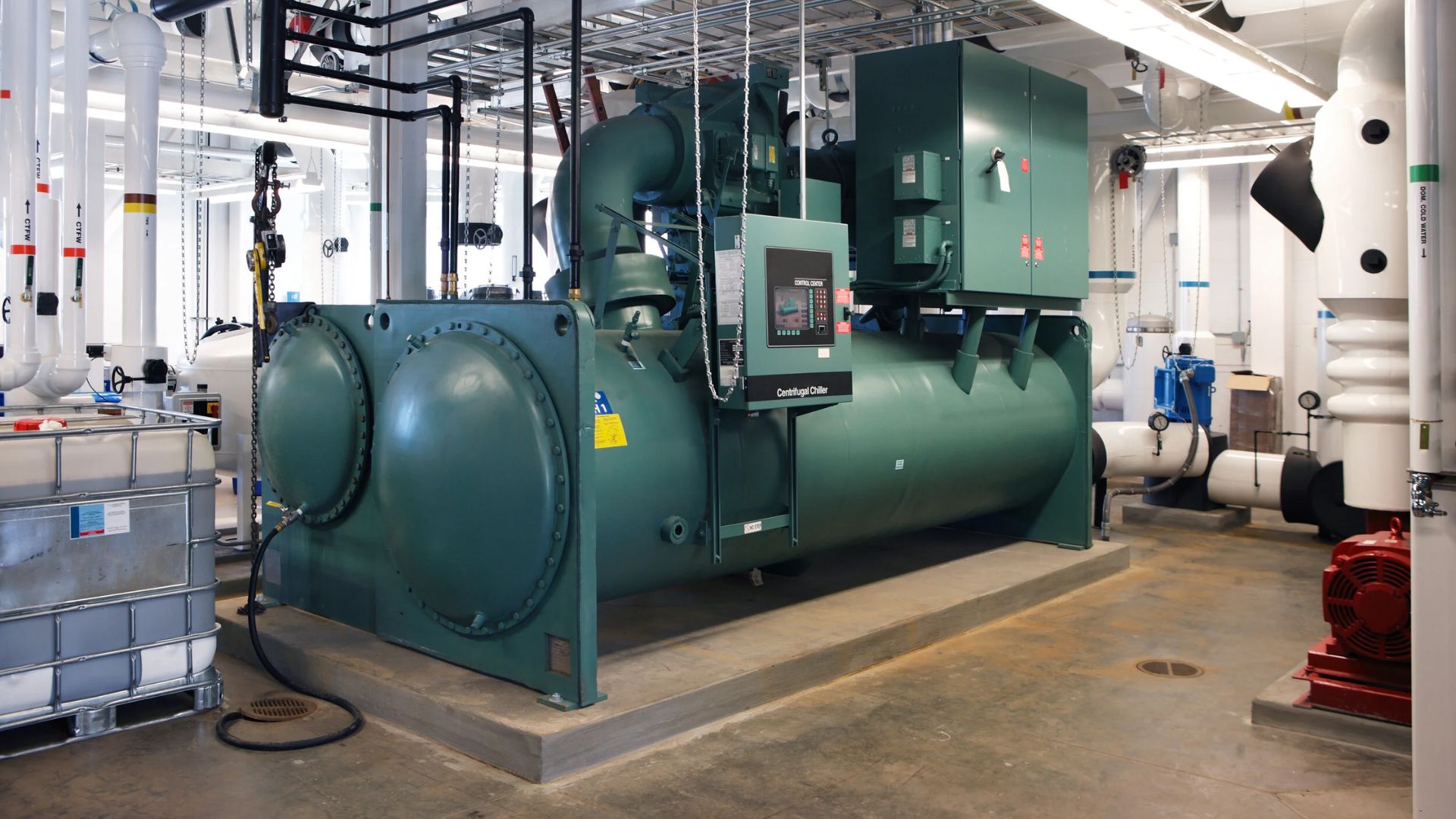

Space cooling is quietly becoming the world’s hungriest “background load.” The International Energy Agency says it is now the fastest-growing source of energy demand in the buildings sector, climbing by almost 4% a year to 2035 under today’s policy settings.
Now, here’s the part that procurement teams and plant ops both feel in their gut. In a plant, cooling systems are not about comfort. They decide whether cycle times hold, whether scrap stays predictable, and whether a “normal” shift suddenly turns into alarms, clogged strainers, and finger-pointing.
The tricky bit is that “cooling system” can mean five different things depending on who’s talking: chiller, cooling tower loop, dry cooler, mold circuit, packaged skid. If you do not lock the definition first, you can end up approving a quote that looks fine on paper but later costs you uptime.
This guide breaks down cooling systems in plain plant terms so you can choose the right setup and compare quotes apples-to-apples.
Key Takeaways:
Scope first: Define what “cooling systems” include before you compare quotes.
Pick the right type: chiller tower or dry cooler, depending on temperature certainty, water ownership, and peak conditions.
Watch for early warnings: Drift, rising DP, and plugged strainers appear before failures.
Force it in writing: Assumptions, filtration location, and commissioning pass/fail criteria.
Use the checklist: Standardize your RFQ so you avoid downtime-causing scope gaps.
What “Cooling Systems” Means
In a plant, cooling systems are not a single machine. They are the full path heat takes to leave your process, without wrecking cycle time, quality, or uptime. If this sounds simple, it is. The chaos starts when different teams mean different “cooling” in the same conversation.
Cooling system in plant terms: heat source → heat transport → heat rejection → controls
If any one of these is missing from the scope, your quote is not complete. It is just incomplete paperwork.
The 3 scope gaps that create bad quotes
Equipment-only quote vs system + integration
One vendor quotes a chiller. Another assumes pumps, piping, tie-ins, controls, and commissioning are included. Both call it a “cooling system.” Only one is real.
Process cooling vs facility HVAC
HVAC keeps people comfortable. Process cooling keeps production stable. Mixing the two leads to wrong temperatures, wrong priorities, and surprises during peak load.
Closed loop vs open loop used loosely
Some mean “tower water exposed to air.” Others mean “once-through.” Others mean “our process water is basically unmanaged.” Same words, different risks. That is why the quotes do not match.
Now that the scope is clear, let’s map the major cooling system types so you can quickly label what you actually have or what you should buy.
The 5 Major Types of Cooling Systems

Most “cooling systems” conversations go sideways because everyone starts in the middle. This taxonomy keeps it clean. Pick the type first, then talk about sizing, controls, and scope. Buyers like it because it makes quotes comparable. Ops like it because it maps to real failure patterns on the floor.
1. Air cooling
Air cooling uses ambient air to remove heat from a fluid via a heat exchanger. Think fin-fan radiators, air-cooled coils, or air-cooled heat exchangers with fans moving air across fins.
Where it fits
Best when you want a simpler setup with less water chemistry drama. Common in plants that prefer lower maintenance overhead, have limited water access, or want to avoid tower-related treatment and cleaning cycles.
Common failure mode
Fouled fins from dust, lint, or oily airborne debris
Fan or motor failures that quietly reduce capacity
High ambient days are causing temperature drift under peak load
Airflow short-circuiting due to poor placement or recirculation
What to specify in the RFQ
Worst-case ambient design condition (summer peak, not average)
Required supply temperature at the process, not at the unit
Heat load and allowable temperature rise (ΔT)
Air-side cleanliness assumptions and cleaning access requirements
Controls requirements (fan staging or VFD, alarms, trending points)
2. Liquid cooling
Liquid cooling uses a circulating fluid, usually water or a water-glycol mix, to remove heat from the process and transfer it to a heat rejection device or chiller. It is the “plumbing backbone” that ensures stable cooling across multiple machines and zones.
Where it fits
Best for plants that need consistent temperatures, longer distribution runs, or multiple heat loads that have to behave like one system. Also common where freeze protection matters, or where processes need tighter control than air cooling can reliably deliver.
Common failure mode
Fouling and scaling inside heat exchangers or small passages
Air entrainment causes unstable flow, cavitation, and hot spots
Pump issues from incorrect sizing, NPSH problems, or worn seals
Flow imbalance across branches leads to “one machine always runs hot.”
Glycol concentration errors that reduce heat transfer or create corrosion risk
What to specify in the RFQ
Process supply temperature requirement and allowable return temperature
Total heat load plus how many zones/machines it serves
Required flow rates per branch and balancing approach
Fluid type and freeze protection requirements (water vs glycol %, temp limits)
Filtration location and what it is protecting (molds, HX, TCUs)
Expansion tank, venting, air separation, and makeup strategy
Trending points and alarms (supply/return temp, ΔP, flow, pump status)
3. Evaporative cooling
Evaporative cooling rejects heat by evaporating a small portion of water into the air. A cooling tower (or evaporative condenser setup) uses airflow and water contact to quickly dump heat, especially when the air is dry.
Where it fits
Best when the plant has large heat loads and wants efficient heat rejection without relying entirely on refrigeration. Common in central utility loops feeding multiple processes, and in facilities that can run a disciplined water treatment and maintenance program.
Common failure mode
Scale and fouling that reduce heat transfer and drive temperature drift
Biological growth that plugs strainers, coats surfaces, and creates odor issues
Poor blowdown or makeup control leading to unstable water quality
Basin debris and clogged distribution nozzles are cutting tower performance
Seasonal capacity swings on hot, humid days when rejection margin shrinks
What to specify in the RFQ
Required leaving water temperature and realistic performance expectations at peak wet-bulb conditions
Water quality assumptions, treatment ownership, and monitoring expectations
Filtration requirements and where filtration sits in the loop
Blowdown, makeup, and conductivity control scope (included vs customer-provided)
Materials of construction and corrosion protection assumptions
Access for cleaning, drift eliminators, basin maintenance, and isolation valves
Controls and visibility: trend points, alarms, and what defines “acceptable performance” during commissioning
4. Refrigeration-based cooling
Chillers use a refrigeration cycle to remove heat from a process fluid and reject it elsewhere. Unlike towers or dry coolers, a chiller can maintain a tighter leaving temperature because it is not limited to ambient air the way they are.
Where it fits
Best when your process needs a specific supply temperature that ambient-based heat rejection cannot reliably hit, especially during peak summer conditions.
Common for temperature-sensitive production, higher precision molding, and plants that value repeatability over “good enough most days.”
Common failure mode
Fouled condenser or evaporator surfaces that quietly cut capacity
Poor water quality or filtration is causing heat exchanger plugging
Refrigerant or oil management issues are reducing efficiency and Stability
Short-cycling from incorrect sizing or poor control setup
Pump/flow issues that create unstable leaving temperatures in the process
What to specify in the RFQ
Required leaving water temperature range and stability requirement for the process
Heat load profile: steady vs variable, peak demand, and future expansion margin
Condenser type and site constraints (air-cooled vs water-cooled)
Minimum and maximum flow requirements and pump/control responsibility
Filtration and water quality assumptions for both evaporator and condenser loops
Redundancy expectations (N+1, lead-lag sequencing, bypass strategy)
Controls, trending, alarms, and commissioning acceptance criteria (capacity test conditions)
5. Hybrid / packaged systems
Hybrid or packaged cooling systems combine heat rejection, pumping, controls, and sometimes filtration into a more “single-assembly” solution.
Where it fits
Best when you want faster deployment, tighter scope control, and fewer integration gaps between vendors. Common for plants with limited engineering bandwidth, limited space, or a need to standardize cooling across multiple lines or locations.
Common failure mode
Hidden integration assumptions that surface during startup
Control handoff issues between packaged controls and plant controls
Fouling on coils or heat exchangers when cleaning access is not planned
Water-side maintenance surprises on adiabatic features (pads, spray systems)
Capacity shortfalls on extreme ambient days if peak conditions were not specified
What to specify in the RFQ
Exact system boundary: what is included vs what remains plant-supplied (tie-ins, drains, controls, power)
Required leaving temperature and performance at worst-case ambient conditions
Cleaning access and maintenance procedure requirements for coils/HX
Controls integration: protocols, trend points, alarms, and ownership of tuning
Commissioning plan with acceptance criteria and responsibilities
Space, noise, and placement constraints to avoid airflow recirculation issues
Future expansion expectations and how additional loads get added cleanly
With the main types clear, the next step is the comparison everyone actually searches for, because it’s where most buying decisions get stuck.
Chillers vs Cooling Towers vs Dry Coolers

These three get lumped together as “cooling systems,” but they solve different problems. The clean way to compare them is to ask one question: Do you need temperature certainty, or do you need heat rejection efficiency, or do you need simplicity with fewer water variables?
ASHRAE groups common heat-rejection equipment categories, such as dry coolers, open-circuit cooling towers, and evaporative condensers, under heat-rejection equipment.
That is the right frame for this decision matrix: what you are buying is a heat rejection strategy.
Decision factor | Chiller | Cooling tower | Dry cooler (air-based heat rejection) |
What it is | Uses a refrigeration cycle to deliver a controlled leaving fluid temperature | Uses evaporation to reject heat; performance is tied to wet-bulb conditions. | Uses ambient air across a coil, performance tied to dry-bulb conditions |
Best when you need | Tight, repeatable supply temperature for the process | High heat rejection capacity with strong efficiency potential | Lower water complexity and a simpler heat rejection path |
Temperature capability | Most stable and controllable leaving temp | Limited by the ambient wet-bulb and tower conditions | Limited by ambient dry-bulb and coil condition |
Seasonal/ambient sensitivity | Lower sensitivity than ambient-only options, still affected by condenser conditions | High sensitivity on hot, humid days | High sensitivity on very hot days |
Water chemistry ownership | Lower than tower loops if closed and well-managed | High and ongoing treatment discipline is part of the system | Lo usually avoids constant water treatment cycles |
Common “first pain” when it goes wrong | Capacity drift, short-cycling, heat exchanger fouling, unstable temps at the process | Scale, biofouling, plugging, rising blowdown needs, performance drift | Fouled fins, fan failures, airflow recirculation, summer peak drift |
Installation and integration complexity | Medium to high, depends on condenser type and distribution | Medium to high, plus water treatment and controls scope | Medium, often simpler than towers, but placement is critical |
Energy tendencies | Can be higher energy than ambient-only rejection, but buys temperature certainty.y | Can be very efficient for large loads, especially in drier conditions | Efficient in cooler seasons, can struggle at peak summer |
Most important RFQ line items | Leaving the temp range and Stability at the process, load profile, redundancy, flow limits, control points, and acceptance test | Design wet-bulb, treatment ownership, filtration placement, blowdown/makeup scope, access for cleaning, acceptance test | Design dry-bulb, placement, and recirculation avoidance, coil access for cleaning, fan control strategy, and acceptance test |
Quick selection cue
If the process cannot tolerate drift, start with a chiller.
If the load is large and you can own a water treatment system, consider a cooling tower.
If you want simpler operation and fewer water variables, look hard at a dry cooler.
Once you pick the heat-rejection path, the real performance comes down to what’s inside the system and how those parts work together under load.
Cooling System Technology Stack (What’s Inside the Box)
Cooling systems fail less from “bad equipment” and more from missing pieces between equipment. This stack is the stuff that decides whether temperatures stay stable after day one.
Heat exchangers
Where heat actually transfers. If the surface fouls or access is poor, capacity falls,s and temperatures drift.
Pumps and flow control
Flow is what delivers cooling to the process. Variable-speed pumping can cut energy and match demand, but only if the system is sized and tuned correctly.
Sensors and controls
Supply/return temperature, differential pressure, and flow signals keep the system stable. Bad sensor placement or weak control tuning shows up as hunting and inconsistent cooling.
Filtration
Filtration is a protection strategy, not a checkbox. It must be clear what is protected first (molds, TCUs, heat exchangers) and where filtration sits, or plugging becomes your new normal.
Water management and treatment (tower-based systems)
For cooling towers, water conditions drive scale, fouling, and biological growth risk. CDC guidance emphasizes operation and maintenance controls to limit Legionella growth conditions, so treatment ownership cannot be “assumed.”
Commissioning and acceptance tests
“It runs” is not acceptance. Define test conditions, required temperatures/flows, alarms/trending, and who owns tuning during the first weeks.
Now let’s talk about how cooling systems usually fail in real plants, because the patterns repeat.
The Failure Modes That Keep Repeating
Most cooling system problems do not start as a breakdown. They start as small, repeatable “tells” on the floor. If you can spot the pattern early, you can fix the cause instead of living in cleanup mode.
Floor symptom (fast skim) | Likely root cause | RFQ / scope line to prevent it |
Temps drift mid-shift | No peak-load margin, dirty heat transfer, and ambient limits | Design for worst-case day, define acceptance test conditions |
DP climbs, strainers plug | Fouling, debris, and filtration in the wrong place | Specify filtration location + protection target + service access |
Only some machines run hot | Flow imbalance, undersized branches | Include branch flow requirements + balancing plan + test points |
Small valves/TCUs keep failing | Fine contamination is hitting small passages | Require upstream protection for “smallest passage” equipment |
Pump noise, random cooling loss | Air entrainment or cavitation | Specify venting/air removal + minimum suction conditions |
Controls hunt, temps swing | Bad sensor placement, weak tuning, no trend visibility | Require trend points + alarm logic + tuning ownership post-start |
Commissioning turns into blame | No written responsibilities or pass/fail criteria | Include commissioning plan + acceptance criteria + exclusions list |
If you’re seeing two or more of these patterns, the fastest win is usually a scope reset: lock what “cooling system” includes, then specify ownership, filtration, access, and acceptance tests before you spend on new equipment.
Next is a quick selection checklist to standardize requirements and stop quote gaps before they turn into downtime.
A 2-Minute Cooling System Selection Checklist

If you want fewer surprises, stop shopping for “cooling equipment” and start writing an RFQ that defines the cooling system. This checklist forces vendors to quote the same assumptions, so you can compare apples to apples and avoid the classic trap: a low number that becomes your problem after startup.
Copy this into your RFQ and fill in the blanks.
Process target
Supply temp at process: ____ Return temp: ____ Stability: tight/moderate
Heat load
Peak load: ____ Future expansion (12–24 mo): ____ Load profile: steady / variable
Design conditions (must be stated)
Worst-case summer condition: ____
Tower quotes must state wet-bulb; air systems must state dry-bulb
Scope boundary (no hidden work)
Included: pumps, valves, tie-ins, drains, electrical, controls integration
Require a 1-page exclusions list
Heat rejection choice
Chiller/tower / dry cooler/hybrid
If hybrid: when it switches and why
Flow and distribution
Flow per machine/zone: ____
Balancing method + test points included
Fluid and water ownership
Water or glycol %: ____
Water treatment responsibility stated (who supplies, monitors, and corrects)
Filtration and protection target
Protect first: molds / TCUs / heat exchangers/valves
Filtration location shown on a simple schematic
Serviceability
Isolation valves for key components
Cleaning access plan without major shutdown work
Controls and visibility
Trend points: supply temp, return temp, flow, DP, pump status
Alarm points defined
Commissioning and acceptance
Pass/fail criteria written
Acceptance test at defined load + ambient
Tuning support window stated
If you’re in IL, WI, MN, ND, or SD, the next step is to get a local engineering review so your cooling system scope holds up after startup.
How Aqua Poly Helps Plants Specify and Support Cooling Systems
Cooling projects usually go wrong in the handoff between “what was quoted” and “what the plant actually needs.” Aqua Poly steps into that gap with practical engineering and startup support, so your cooling systems perform after day 1, not just during the sales pitch.
Equipment selection that matches plant reality
Helps you choose the right cooling approach based on load, temperature targets, ambient limits, and maintenance capacity, not generic pros and cons.
Engineering and integration support
Aligns the full scope across heat rejection, pumps, piping, filtration, and controls so you do not get stuck with missing tie-ins, unclear responsibilities, or “customer provided” surprises.
Installation and startup support
Supports commissioning and handoff so performance checks, tuning, and acceptance expectations are clear before production ramps up.
Process cooling and temperature control ecosystem
Supports process cooling and temperature control needs through equipment lines listed on the Aqua Poly site, including AEC, Conair, and Thermal Care, plus supporting system components that keep performance stable.
Material handling coordination around cooling-dependent processes
Helps plants align cooling decisions with upstream and downstream needs like conveying, drying, and blending, so one upgrade does not create a bottleneck somewhere else.
Parts and technical support after installation
Helps source replacement parts and troubleshoot when temperatures drift, pressure drop climbs, or controls act unstable, so issues do not turn into long downtime cycles.
If your plant is in Aqua Poly’s service region (Illinois, Wisconsin, Minnesota, North Dakota, and South Dakota) and you want a quick scope sanity-check before you commit, use the Contact Us page to start the conversation.
Conclusion
Cooling systems do not usually fail loudly. They fail quietly, with small temperature swings that stretch cycle time, a slow rise in pressure drop, and “maintenance” that turns into a weekly ritual.
The fastest way to stop that pattern is to treat cooling like a spec problem, not a hardware problem: lock the system boundary, write down water and filtration ownership, and require a pass or fail commissioning test under peak conditions.
If your plant is in Illinois, Wisconsin, Minnesota, North Dakota, or South Dakota, Aqua Poly can sanity-check the cooling systems scope, integration points, and startup plan before you sign.
FAQs
1. What’s the most common reason cooling systems “work” on day one but drift later?
Hidden scope gaps plus fouling under real load, especially when peak summer conditions were not sized or tested.
2. Do I need a chiller, or can a tower or dry cooler handle my process?
If your process needs a tight, repeatable supply temperature at peak conditions, a chiller is usually the safer baseline.
3. Where should filtration go in a cooling system?
It depends on what you must protect first: molds, TCUs, or heat exchangers, so the filtration location should be shown in the quote schematic.
4. What should commissioning prove before production ramps up?
The system holds required temperatures and flows under defined load and ambient conditions, with alarms and trend points working.
5. What details should procurement force into writing to prevent quote surprises?
System boundary, water or glycol assumptions, treatment ownership, filtration scope, cleaning access, and acceptance criteria.