
Temperature drift starts small. Line speeds slow down slightly, parts that ran clean last week now show surface marks, and restart cycles take longer than they should. By the time production teams connect the pattern to cooling, scrap has already accumulated.
For plant managers and operations leaders responsible for plastics manufacturing, understanding what the top commercial cooling systems available are is not about finding the highest-performing brand. It is about identifying which cooling structure fits how your plant operates, how heat loads distribute across shifts, and where cooling failures create the most risk.
This article explains the commercial cooling system options most commonly evaluated in plastics manufacturing. It describes how each system type handles heat rejection, where it typically performs well, and what operational trade-offs it introduces. You will learn when different cooling approaches make sense, what mistakes increase risk, and how to evaluate fit before installation.
Key Takeaways
There is no single “top” cooling system for plastics manufacturing. Central, dedicated, air-cooled, water-cooled, and process-specific systems solve different heat-load and stability problems.
The cooling system's structure directly impacts uptime and scrap. Mismatched cooling causes temperature drift, unstable cycle times, and seasonal production losses.
Cooling failures usually start at specification, not operation. Treating cooling as a utility and ignoring integration or maintenance needs increases long-term risk.
Capacity alone does not ensure stable cooling. Heat-load distribution, ambient conditions, and process integration determine real-world performance.
Engineering-led selection reduces cooling risk. Evaluating systems based on process behavior and support capability leads to more predictable production.
Why Cooling System Choice Matters in Plastics Manufacturing?
Cooling problems rarely show up as obvious system failures. More often, they appear as production issues that are difficult to isolate during normal troubleshooting.
Plants typically show symptoms such as:
Mold temperatures that drift between shifts.
Cycle times that are difficult to hold consistently.
Scrap levels increase during hot or humid conditions.
In many cases, these issues persist even after machines, molds, and materials have been reviewed and adjusted.
The underlying problem is often a mismatch between the cooling system and how heat is actually generated and removed. Systems designed for steady, predictable loads may struggle when production involves frequent changeovers, mixed tooling, or tight thermal windows.
When cooling is treated as a background utility, its impact on process stability is easy to underestimate. As production demands increase, cooling becomes part of the control strategy rather than just a support system.
At that point, the cooling system choice directly affects:
Process consistency across shifts.
Recovery time after downtime or restarts.
Sensitivity to seasonal and ambient conditions.
Overall uptime and scrap risk.
Framing cooling system selection this way helps clarify why different cooling approaches exist and why they are not interchangeable in plastics manufacturing.
Types of Commercial Cooling System Options Used in Plastics Manufacturing
Different cooling systems handle heat rejection in different ways. Each serves specific production conditions and creates distinct operational patterns.

The sections below describe the cooling options most commonly evaluated in plastics manufacturing, where they typically fit, and the operational trade-offs they introduce.
Central Chiller Systems
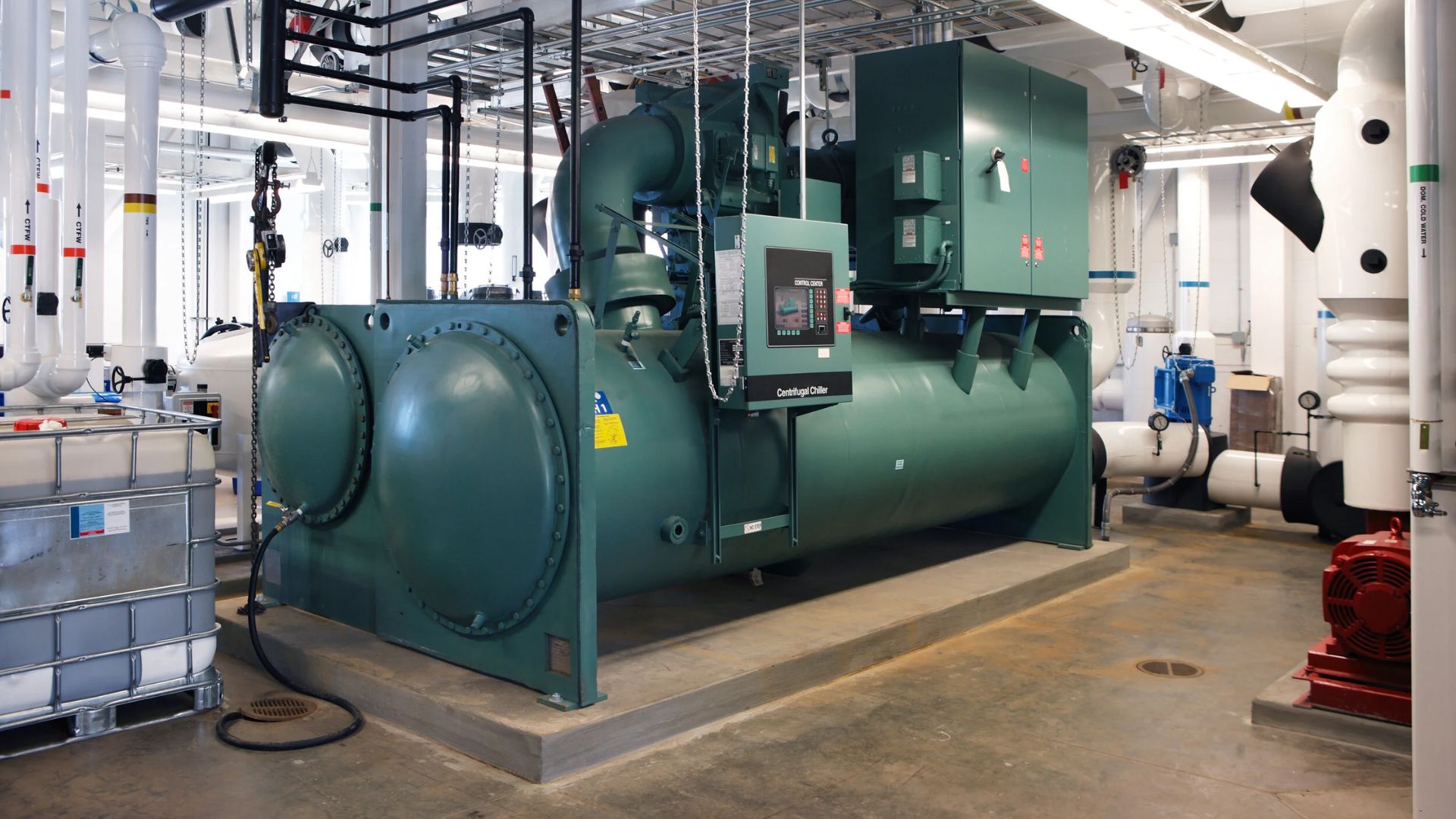
Central chiller systems supply cooling to multiple molding machines or process lines from a single location. They are commonly used in plants with steady production schedules and relatively predictable cooling demand.
By consolidating cooling equipment, these systems simplify monitoring and reduce component duplication across the floor.
Operational trade-offs to consider:
A single failure can affect multiple machines at once.
Distribution losses increase as piping runs get longer.
Maintenance activities must be carefully scheduled to avoid widespread downtime.
Central systems tend to work best when redundancy, load stability, and maintenance coordination are well planned.
Dedicated or Machine-Side Chillers
Dedicated chillers are installed at individual presses or process lines and operate independently from other equipment.
They are often used in plants with frequent changeovers, mixed tooling, or processes that require tighter thermal control at specific machines.
Operational trade-offs to consider:
Higher equipment count increases inspection and service effort.
Floor space and electrical demand can become limiting factors.
Inconsistent maintenance across units can introduce variability.
These systems reduce shared risk but shift responsibility toward localized upkeep and discipline.
Cooling Towers with Heat Exchangers
Cooling towers are used to reject large amounts of heat and are typically paired with closed-loop process cooling through heat exchangers.
They are commonly specified in plants with high, continuous heat loads and established water treatment programs.
Operational trade-offs to consider:
Water quality directly affects reliability and heat transfer.
Seasonal conditions influence performance and maintenance needs.
Scaling, fouling, and corrosion require ongoing attention.
Cooling towers can be effective, but only when water management and preventive maintenance are consistently maintained.
Air-Cooled Chiller Systems
Air-cooled chillers use fans and ambient air to reject heat. These systems do not need water infrastructure, making installation simpler and relocation easier.
Air-cooled chillers are commonly selected when:
• Water availability is limited or restricted.
• Plants want to avoid water treatment complexity.
• Space constraints need compact solutions.
• Equipment may need to be moved between locations.
These systems can be installed on rooftops, outdoor pads, or near process equipment without extensive piping or water-supply modifications.
Operational trade-off: More sensitive to ambient temperature swings. Air-cooled chillers lose efficiency as outdoor temperatures rise. On hot days, cooling capacity drops and energy consumption increases. Plants in regions with wide seasonal variation may see inconsistent performance throughout the year.
Water-Cooled Chiller Systems
Water-cooled chillers use water as the heat rejection medium. These systems typically integrate with cooling towers or heat exchangers to create closed-loop cooling circuits.
Water-cooled chillers are often used when:
• Stable cooling performance is needed across seasons.
• Heat loads are high or continuous.
• Energy efficiency is a priority.
• Space inside the plant is limited.
Water-cooled systems generally operate more efficiently than air-cooled systems because water transfers heat more effectively. This can reduce operating costs over time, especially in facilities with high continuous cooling demands.
Operational trade-off: Needs supporting water infrastructure and ongoing monitoring. Water-cooled chillers need a reliable supply, proper filtration, and regular quality checks. Plants must manage pumps, piping, and treatment systems to prevent scale, corrosion, and biological growth.
Process-Specific Cooling and Temperature Control Units
Process-specific cooling units, including mold temperature controllers and portable temperature control units, support precise thermal management at individual process points. These often work alongside central or dedicated chillers to maintain tight temperature control.
These units are critical when:
• Process windows are narrow.
• Surface quality requirements are strict.
• Startup stability matters.
• Mold temperatures must be controlled independently from general process cooling.
Process-specific units help stabilize production when cooling alone is not enough. They allow teams to maintain specific mold surface temperatures while the main cooling system handles overall heat rejection.
Operational trade-off: Poor integration can introduce instability even with capable equipment. If temperature control units are not properly sized, timed, or coordinated with the main cooling system, they can cause temperature cycling or control conflicts, leading to increased scrap and process variation.
Seeing how different cooling system options function makes it easier to compare their effects on daily operations.
Common Cooling System Selection Mistakes That Increase Risk
Cooling system problems often start during selection and specification. These mistakes typically create operational issues that appear weeks or months after installation, when production conditions change, or heat loads shift.
Treating Cooling as a Utility Instead of a Process System
Cooling is sometimes specified based on available plant utilities rather than how heat is generated and removed during the process.
How to reduce the risk:
Map where heat enters and exits the process.
Review cooling needs at the mold or process level, not just at the central level.
Include engineering and operations early in the discussion.
Selecting Capacity Without Understanding Heat Load Distribution
Sizing decisions are often made using nameplate values without confirming how heat is distributed across machines or cycles.
How to reduce the risk:
Identify which processes are most sensitive to temperature variation.
Review startup, changeover, and peak-load behavior.
Avoid assuming uniform demand across all equipment.
Ignoring Seasonal and Ambient Operating Conditions
Cooling systems that perform adequately in mild conditions may struggle during hotter or more humid periods.
How to reduce the risk:
Evaluate cooling behavior during worst-case ambient conditions.
Account for seasonal load changes in planning discussions.
Review how past temperature swings have affected production.
Overlooking Water Quality and Maintenance Requirements
Water treatment and filtration needs are sometimes addressed after installation rather than during system evaluation.
How to reduce the risk:
Confirm water quality requirements early.
Align system choice with existing treatment and maintenance capabilities.
Factor ongoing inspection and cleaning into planning.
Assuming New Equipment Will Fix Existing Process Issues
Cooling upgrades are sometimes approved to address instability caused by unrelated tooling, control, or integration problems.
How to reduce the risk:
Confirm root causes before changing equipment.
Validate that cooling is the limiting factor.
Avoid layering complexity on unresolved process issues.
Underestimating Integration and Support Needs
Cooling systems are often evaluated in isolation, without fully considering their interactions with presses, molds, and auxiliary equipment.
How to reduce the risk:
Review integration points with existing equipment.
Clarify startup and support responsibilities.
Plan validation time under real production conditions.
Skipping Internal Alignment Before Specification
Misalignment between procurement, engineering, maintenance, and operations can lead to unrealistic expectations.
How to reduce the risk:
Align on performance goals and constraints early.
Clarify maintenance and operational ownership.
Document assumptions before final approval.
Questions to Ask Before Specifying a Commercial Cooling System

Selecting a cooling system needs more than matching capacity to heat load. The questions below help identify operational fit, integration requirements, and long-term maintenance considerations.
What is the typical heat load during normal production, not just peak capacity? Cooling systems should be sized for actual operating conditions with an appropriate margin, not theoretical maximum loads that rarely occur.
How does heat load vary across shifts, seasons, or production schedules? Understanding load variation helps determine whether centralized or distributed cooling makes more sense.
What happens to production if the cooling system goes offline? This question reveals downtime risk and whether backup capacity or redundancy is needed.
What maintenance capacity does the plant have for cooling equipment? Systems with more components need more inspection time and preventive maintenance. Plants with limited maintenance resources may need simpler, more centralized approaches.
Are there existing water treatment programs or infrastructure? Water-cooled systems and cooling towers depend on disciplined water quality management. Plants without established programs may face higher operating risks.
How does ambient temperature affect cooling performance throughout the year? Air-cooled systems lose capacity as outdoor temperatures rise. Local climate should influence the selection of a cooling system.
What are the integration requirements for existing presses and auxiliary equipment? Flow rates, pressure requirements, connection types, and control compatibility must be validated before purchase.
Where will the equipment be installed, and is there adequate maintenance access? Physical placement affects serviceability, noise, and how easily technicians can perform routine maintenance.
What monitoring and diagnostic capabilities are needed? Systems with adequate instrumentation support faster troubleshooting and better root-cause identification.
These questions help teams evaluate cooling system fit in light of operational realities.
Why Engineering-Led Evaluation Reduces Cooling System Risk?
Cooling system selection is not a purchasing decision. It is an engineering decision that affects production stability, maintenance workload, and operating costs.
Engineering-led evaluation starts with understanding how the plant operates. It accounts for heat load distribution, production variability, seasonal conditions, and existing infrastructure. It considers how the cooling system will integrate with presses, molds, and auxiliary equipment.
This approach reduces risk by identifying potential problems before installation. Integration issues, capacity mismatches, and maintenance challenges can be addressed during specification rather than discovered during commissioning.
Engineering-focused partners help teams:
Size cooling systems based on actual operating conditions.
Validate integration with existing equipment.
Identify maintenance and serviceability requirements.
Plan for seasonal and ambient temperature effects.
Avoid oversizing or undersizing mistakes.
When cooling system evaluation prioritizes engineering over product features, plants are more likely to achieve stable performance from day one.
How Aqua Poly Supports Plastics Manufacturing Cooling Decisions?
Cooling system performance depends on proper selection, integration, and support. Aqua Poly Equipment helps manufacturers across Illinois, Wisconsin, Minnesota, and the Dakotas evaluate cooling system fit based on actual production conditions.
Their engineering-focused approach emphasizes:
• Use-Fit Equipment Selection: Aqua Poly assists in evaluating plastics process cooling equipment and auxiliary equipment based on heat load, production variability, and plant operating conditions.
• Integration Guidance: They help validate compatibility with existing presses, molds, and process equipment to avoid installation delays and performance issues.
• Startup and Commissioning Support: Aqua Poly provides assistance during installation and startup to help teams establish proper operation and avoid early stability problems.
• Regional Technical Support: As a regional equipment partner representing multiple brands, Aqua Poly offers accessible parts and service support to minimize downtime.
• Realistic Expectations and Long-Term Maintainability: Their focus on engineering-led selection helps plants sustain uptime and reduce unexpected issues.
When cooling system evaluation emphasizes operational fit and long-term support, plants are better positioned to maintain stable production.
Final Thoughts!
Choosing a commercial cooling system is ultimately a decision about risk, not equipment. The systems that perform best over time are those selected with a clear understanding of how the plant actually runs and the level of stability the operation expects.
When cooling decisions are guided by engineering context rather than specifications alone, plants avoid many of the downstream issues that disrupt production later. Fit, integration, and long-term support matter more than headline capacity or individual features.
For manufacturers reviewing new cooling options or reassessing existing systems, Aqua Poly Equipment supports this process with an engineering-led approach focused on real operating conditions. Their role is to help teams evaluate cooling choices in context, align expectations early, and select solutions that hold up over time.
If you are planning a cooling system change or need clarity before committing capital, speak with Aqua Poly to evaluate cooling system fit and reduce avoidable risk before it impacts production.
FAQs
Q1. How do I know if the current cooling system is undersized or poorly matched to my process?
Early signs include temperature drift across shifts, longer restarts, seasonal scrap increases, and operators compensating with manual adjustments despite stable machine settings.
Q2. Can a plant use more than one type of commercial cooling system at the same time?
Yes. Many plastics plants combine central chillers, machine-side units, and process-specific temperature control to balance flexibility, redundancy, and maintenance effort.
Q3. Is upgrading a cooling system usually disruptive to ongoing production?
It can be. Disruption depends on integration complexity, piping changes, validation time, and whether the system is installed during planned downtime or phased commissioning.
Q4. How does plant location or climate influence cooling system selection?
Climate affects ambient sensitivity, heat rejection efficiency, and seasonal stability. Air-cooled and tower-based systems are especially influenced by temperature and humidity swings.
Q5. Who should be involved internally when selecting a commercial cooling system?
Engineering, operations, maintenance, and procurement should all be involved to align process needs, support capability, downtime risk, and long-term ownership.